
TU Delft and International Internships: A Benchmark Study for Technical Universities
Nearly one in five employed TU Delft alumni works internationally after graduation. That figure is not a marketing claim. It comes from TU Delft's own alumni tracking data and it describes an outcome that most European technical universities would consider exceptional. What makes it notable is not that TU Delft has an unusually global campus (though it does), but that its institutional infrastructure specifically supports the kind of formative international experience, principally international internships, that is most strongly associated with international career outcomes.
For university international offices and faculty responsible for internship programmes, TU Delft offers an instructive model. This is not a case study in overnight transformation. TU Delft has built its international internship culture over decades, layering funding support, administrative infrastructure, and programme integration in ways that are replicable but require deliberate institutional investment. This article examines what that model looks like in practice, what the data shows about its outcomes, and what lessons are transferable to other technical universities across Europe.
Key Takeaways
- TU Delft had approximately 26,065 students as of January 2024, with 84% of its master's intake coming from outside the Netherlands and approximately 26% of the total student body being international (TU Delft Facts and Figures, 2024).
- Almost 20% of employed TU Delft alumni work internationally after graduation, a figure that correlates with the university's structured international internship support.
- TU Delft provides layered financial support: Erasmus+ Traineeship Grants of EUR 360-480 per month, plus a dedicated International Internship Fund (EUR 100 for European destinations, EUR 250 for destinations outside Europe).
- Erasmus+ traineeship applications are accepted year-round at TU Delft, with a maximum of 120 funded days per study cycle per student.
- 82% of TU Delft graduates are employed within six months of graduation; the combination of technical depth and international experience is the differentiator most often cited by Dutch engineering employers.
The Number That Matters: International Graduate Employment
University rankings have become a blunt instrument. QS, Times Higher, and their equivalents measure inputs and proxies more reliably than they measure the long-term value a graduate actually receives from their time at an institution. TU Delft sits comfortably in the global top 15 for engineering and technology, which tells you something about research output and faculty credentials. It does not tell you much about what happens to graduates.
The 20% international employment rate among TU Delft alumni is more revealing. It is not a benchmark that any institution can manufacture through messaging or by changing the wording on a careers page. It reflects a graduate population that is genuinely equipped to navigate international labour markets: fluent in cross-cultural professional environments, experienced in working with teams from different countries, and credible to employers who evaluate candidates with an international lens.
What sits upstream of that outcome? The answer is largely structural. TU Delft does not produce internationally employed engineers simply because it attracts ambitious students, though it does attract ambitious students. It produces them because it has built a support system that makes international internship experiences accessible, funded, and administratively manageable for students across all its faculties.
The International Profile of TU Delft: Starting From the Inside
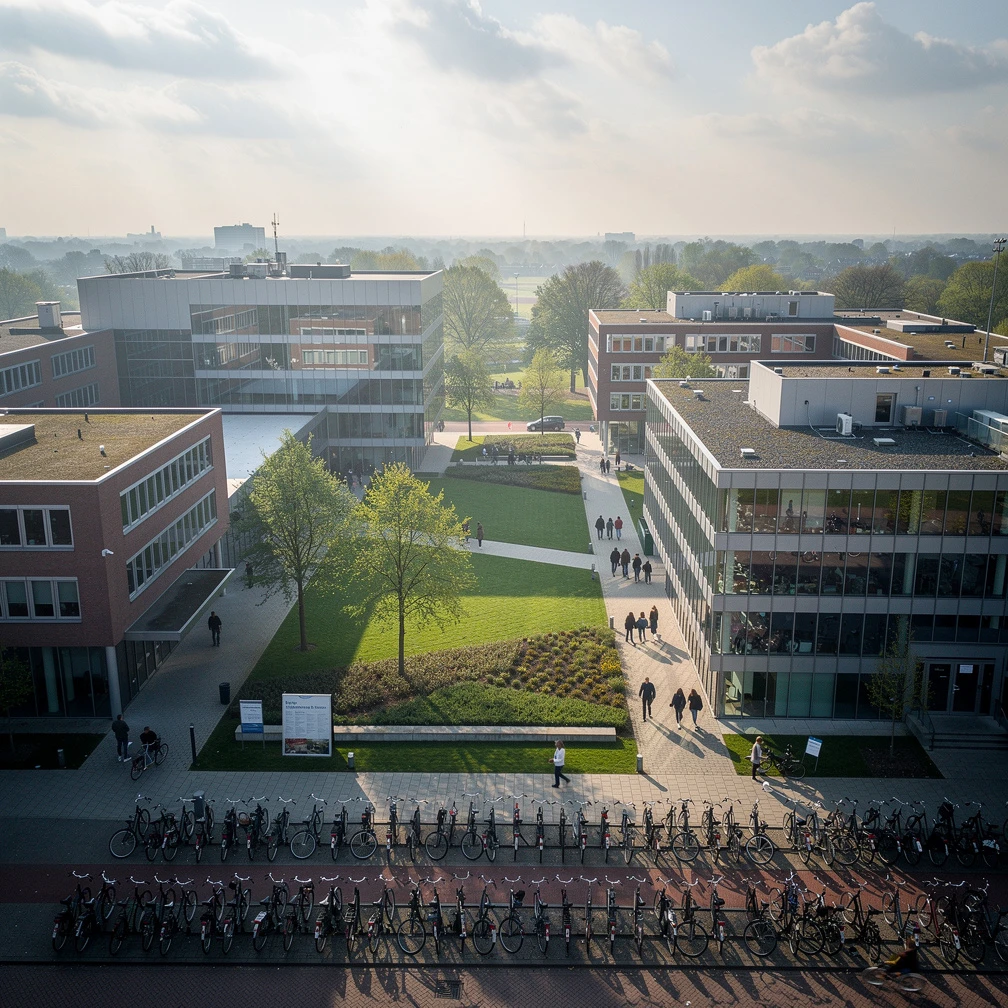
Any discussion of TU Delft's approach to international internships has to begin with the composition of its campus, because the campus itself is an internationalisation instrument. As of 2024, approximately 26% of TU Delft's total student body was international, roughly 6,900 students out of 26,065. The three largest sending countries were China (14%), India (11.4%), and Belgium (7.4%).
At master's level, the internationalisation is more pronounced: 84% of first-year master's students came from outside the Netherlands. This is not typical for European technical universities. Most engineering schools in Germany, France, and Italy retain predominantly domestic master's cohorts, with international students representing 20-35% at most. TU Delft's inverted ratio at master's level means that international perspective is built into the default classroom dynamic, not added as a special programme.
This matters for international internships because it affects both supply and demand. Students at TU Delft are surrounded by peers from different countries who have connections, language skills, and market knowledge that open up international placement opportunities informally, not just through official programme channels. A Dutch civil engineering student working on a group project with classmates from India, Vietnam, and Brazil is already building the network and the cross-cultural confidence that makes an international internship a natural next step rather than an anxious departure from familiar ground.
The broader Dutch higher education context reinforces this. The Netherlands consistently ranks among Europe's most internationally mobile student populations. For analysis of the Dutch university landscape specifically, see our earlier piece on Dutch universities and international internships, and the Dutch platform at internshipabroad.nl for country-specific placement data.
How TU Delft Structures International Internship Support
TU Delft's approach to international internship support is best understood as a layered system. No single mechanism is sufficient on its own. Together, they address the three most common barriers to international internship participation: financial cost, administrative complexity, and the challenge of finding and vetting appropriate placements in unfamiliar markets.
Layer 1: The International Internship Fund
The International Internship Fund (IIF) is TU Delft's institution-level financial support mechanism for students whose curriculum includes a mandatory internship component. It operates on a first-come, first-served basis within an annual budget and provides a one-off grant to offset the additional costs of doing an international rather than domestic internship.
Grant amounts are: EUR 100 for European destinations and EUR 250 for destinations outside Europe. These are not large sums in absolute terms, but the IIF serves an important symbolic and practical function. It signals to students that international internship is an expected and supported option, not a personal extravagance. The differential between European and non-European destinations also provides a mild directional incentive toward non-European placements, which tend to generate stronger differentiation in graduate career outcomes.
Layer 2: Erasmus+ Traineeship Grants
For students doing internships within Erasmus+ programme countries, TU Delft has an active and well-administered Erasmus+ traineeship grant programme. Grant rates as of 2024-2025 were EUR 360-480 per month, with the exact amount depending on the destination country's cost-of-living classification. Students going to higher-cost destinations (Norway, Ireland, Luxembourg, Denmark, Iceland) receive the higher end of that range.
TU Delft processes Erasmus+ traineeship applications on a rolling basis, accepting applications year-round. This is a more generous and student-friendly administrative model than the fixed annual deadlines used by many European universities, which often force students to plan their internship timing around grant windows rather than labour market availability. The maximum funded period under this grant is 120 days per study cycle, meaning a student cannot receive Erasmus+ traineeship funding for more than four months in total across their bachelor's or master's degree at TU Delft.
Both the IIF and the Erasmus+ grant can be used to support a single placement, making the combined ceiling EUR 460-730 per month for European destinations (EUR 360-480 Erasmus+ plus EUR 100 IIF) and EUR 610-730 per month for extra-European destinations where the IIF applies instead.
| Funding Source | Amount | Coverage | Conditions |
|---|---|---|---|
| Erasmus+ Traineeship Grant | EUR 360-480/month | Erasmus+ programme countries | 2-12 months; max 120 days per study cycle; applications accepted year-round |
| International Internship Fund (European) | EUR 100 one-off | European destinations | Curriculum internship component required; first-come, first-served annual budget |
| International Internship Fund (Extra-European) | EUR 250 one-off | Destinations outside Europe | As above |
Layer 3: The International and Internship Office
TU Delft maintains a dedicated International and Internship Office within the Faculty of Electrical Engineering, Mathematics and Computer Science (EEMCS). This is not a central administrative function that processes paperwork at a distance from academic programmes. It is embedded within a faculty, which means it has deep familiarity with the specific technical requirements, safety considerations, and learning outcomes relevant to engineering placements in that discipline.
The existence of faculty-embedded internship support is a structural choice with significant implications. Students seeking internship support do not need to navigate a centralised university bureaucracy; they interact with a team that knows their programme, understands what a meaningful EEMCS internship looks like, and has relationships with relevant host companies in the relevant sectors. The model reduces the friction that causes students to choose domestic over international placements purely because the international option seems more complex to arrange.
The Learning Agreement and TU Delft's Documentation Approach
For international internships that qualify for Erasmus+ funding, TU Delft requires the standard tripartite Learning Agreement: signed by the student, the home faculty, and the host organisation. This is identical to the Erasmus+ traineeship process used at universities across the EU.
What distinguishes TU Delft's documentation approach is not the format but the integration. The Learning Agreement is treated as a genuine academic planning instrument rather than an administrative compliance requirement. Learning outcomes specified in the agreement align with the competency frameworks of the relevant engineering programme. The host company evaluation completed at the end of the placement feeds back into the academic record in a way that recognises the learning that took place.
This integration matters because it changes the incentive structure for students. At universities where international internships are documented separately from the academic record and treated as extracurricular additions, students rationally allocate less effort to them. At TU Delft, where the international internship is explicitly part of the degree structure for many programmes and documented through the same academic systems as coursework, students approach them with corresponding seriousness.
Where TU Delft Students Go: Destination Patterns
TU Delft does not publish a detailed annual breakdown of international internship destinations, but several patterns are visible from the available evidence. European internship destinations are dominated by Germany, Belgium, the UK, and Spain, reflecting both geographic proximity and the concentration of engineering employers in those markets. German automotive and industrial companies have historically been among the most active employers of TU Delft interns; the Dutch-German bilateral relationship is one of the most active student mobility corridors in Europe.
Outside Europe, the United States, Singapore, and Japan are significant destinations, particularly for electrical engineering and computer science students. The IIF's higher grant rate for non-European destinations partly reflects the additional costs these placements involve, but it also reflects a deliberate institutional preference for encouraging students to go beyond the obvious regional markets.
The recent growth in placements to Southeast Asia, including Vietnam, Indonesia, and the Philippines, mirrors a broader European trend. TU Delft's Aerospace Engineering and Industrial Design faculties have been particularly active in establishing relationships with companies and research institutions in these markets. For students from these countries doing placements in Europe, the flow runs in both directions through platforms like internshipabroad.id and internshipabroad.vn.
What the Alumni Data Tells Us
The most striking piece of evidence for the long-term value of TU Delft's internship culture is not a placement rate or a grant utilisation figure. It is the 82% employment rate within six months of graduation, combined with the approximately 20% rate of international employment among those alumni. These figures are consistent with findings from the Erasmus Impact Study (European Commission, 2014), which found that graduates with international mobility experience are 50% less likely to face long-term unemployment, and with more recent QS Graduate Employability Survey data showing that engineering employers globally express strong preference for graduates with documented international work experience.
The causal chain is not simple. TU Delft graduates are highly technically capable, which is itself a significant predictor of employment outcomes. But technical capability is increasingly a minimum threshold rather than a differentiator in engineering hiring. The employers who most actively recruit TU Delft graduates, multinationals in aerospace, semiconductors, water management, and energy infrastructure, are looking for engineers who can also communicate across languages, navigate different regulatory environments, and work effectively with distributed teams. International internships are a direct input to those capabilities.
There is also a signalling effect. A TU Delft graduate who has done an international internship has demonstrated the initiative and adaptability that international employers value. The internship itself functions as a credentialing mechanism, not just a learning experience. Students who understand this are more motivated to seek out international placements; universities that communicate it clearly generate higher voluntary participation rates even before any financial incentive is applied.
The Employability Premium: What the Evidence Shows
Research from the Erasmus Impact Study (European Commission, 2014, n=75,000) found that graduates with international mobility experience are 50% less likely to face long-term unemployment. Statistics Canada's longitudinal study (2022) found a CAD 12,117 additional first-year earnings premium for graduates with international work experience. The AACSB/Sage Corps Alumni Study (2025) found that 87% of graduates with international internship experience secured employment within 3 months, compared to 50% of the general graduate population within 12 months. TU Delft's outcomes are consistent with all three of these trend lines.
What Other Technical Universities Can Learn
Not every European technical university will become TU Delft overnight. The scale of international enrolment, the historic depth of employer relationships, and the institutional culture around internationalisation took decades to build. But several specific features of the TU Delft model are replicable by institutions at any scale, and they are worth examining separately from the totality of what TU Delft represents.
Year-round application windows matter. The shift from fixed Erasmus+ grant windows to year-round rolling applications removed a significant structural barrier. Students planning engineering internships are often constrained by project timelines, thesis schedules, and employer availability. Fixed annual deadlines add an unnecessary layer of friction that disproportionately affects students who need more time to find and secure the right placement. Institutions with the administrative capacity to process Erasmus+ traineeship applications continuously should do so.
Faculty embedding beats central administration. The International and Internship Office model within EEMCS is more effective than a purely central international office because it understands the specific needs of its student population. Technical faculties have specific placement requirements that differ from business or humanities programmes: safety considerations, IP agreements, access to specialised equipment. A faculty-embedded office that understands these is better positioned to support students in finding appropriate placements than a central office that processes all faculties identically.
Layered funding changes the decision calculus. Neither the IIF alone nor the Erasmus+ grant alone would be sufficient to make international internship meaningfully more accessible. Together, they raise the financial floor enough to shift the decision from "can I afford this?" to "which placement is best for me?" That shift is the goal. Universities that have only one funding mechanism should assess whether adding a complementary institutional grant would move more students from consideration to action.
Integration into the academic record drives engagement. When international internships are explicitly part of the degree structure, with Learning Agreements aligned to programme competencies and evaluations that feed into academic records, student engagement quality improves. When they are optional extras documented separately from the main academic record, they remain underutilised by the students who would benefit most.
Partnering with TU Delft: What Host Companies and Universities Need to Know
For companies seeking to host TU Delft engineering interns, the placement relationship typically works through faculty-level contacts and the university's career services, with documentation handled through the Erasmus+ Learning Agreement process where applicable. TU Delft does not maintain a central placement agency; host organisations that want a sustained relationship with TU Delft benefit from building direct faculty contacts and participating in campus recruitment events.
For partner universities interested in student exchange or academic collaboration, TU Delft participates in both Erasmus+ and bilateral exchange programmes across all eight of its faculties. The relevant contact for most exchange enquiries is the faculty's international office rather than the central international services office.
For students at Dutch universities, and for European students looking to do their internship in the Netherlands within the TU Delft cluster, internshipabroad.nl connects students with vetted companies in Delft, The Hague, Rotterdam, and across the Netherlands that are experienced in hosting international engineering and technical interns. For students whose international offices partner with Internship Abroad, the full placement documentation chain, including Learning Agreements and welfare monitoring, is handled through our platform.
For universities looking to build structured international internship partnerships of the kind that TU Delft exemplifies, the Internship Abroad university partnership page sets out how the institutional relationship works across our 16 active markets.
Building an international internship programme?
Internship Abroad works with university international offices across 16 markets to connect students with verified international placements and handle the full documentation chain. Get in touch to discuss your institution's needs.
University PartnershipsSources and Methodology
- TU Delft. Facts and Figures 2024. tudelft.nl/en/about-tu-delft/organisation/facts-and-figures. Accessed June 2026.
- Delta (TU Delft student newspaper). "TU Delft Welcomes Slightly Fewer International Students." delta.tudelft.nl. 2024.
- Delta (TU Delft student newspaper). "TU Delft Graduates Quick to Find Jobs." delta.tudelft.nl. Accessed June 2026.
- TU Delft. International Internship Fund. tudelft.nl/en/student/my-study-me/education/study-abroad/orientation/financial-support/the-international-internship-fund. Accessed June 2026.
- TU Delft. ERASMUS+ Traineeship Grant. tudelft.nl/en/student/my-study-me/education/study-abroad/orientation/financial-support/erasmus-traineeship-grant. Accessed June 2026.
- TU Delft. International and Internship Office, EEMCS Faculty. tudelft.nl/en/student/eemcs-student-portal/organisation/international-internship-office. Accessed June 2026.
- European Commission. Erasmus Impact Study. 2014. A longitudinal study of 75,000+ participants across 34 countries.
- QS World University Rankings. Global Subject Rankings 2024: Engineering and Technology. topuniversities.com. 2024.
- AACSB / Sage Corps. Alumni Employment Study. 2025.
- Statistics Canada. Longitudinal Study on International Work Experience and Graduate Earnings. 2022.